Somewhere in your 40s, the body starts sending signals you didn’t used to get. Stairs feel heavier. Carrying groceries from the car takes more out of you than it used to. Getting up from the floor requires a plan. These aren’t signs that you’re falling apart — they’re signs that your muscles are starting to lose mass at a rate that outpaces your current activity level, a process called sarcopenia that begins as early as your mid-30s and accelerates if you don’t work against it.
The good news: strength training is the most direct intervention there is. And you don’t need a gym membership, expensive equipment, or an hour a day to get meaningful results. You need a consistent two-days-per-week routine and the willingness to show up for it.
What the Guidelines Actually Say
The CDC recommends that adults perform muscle-strengthening activities on at least two days per week, working all major muscle groups — legs, hips, back, abdomen, chest, shoulders, and arms. The American Heart Association echoes this recommendation, noting that resistance training improves cardiovascular risk factors including blood pressure, blood sugar, and body composition, not just muscle mass and bone density.
Two days a week. That’s the floor. If you’re not doing any strength work right now, getting to two days is the entire goal for your first month.
Why It Matters More After 40
Muscle tissue is metabolically active — it burns more energy at rest than fat tissue. As muscle mass declines with age, so does resting metabolic rate, which is one reason many people find that the same eating habits that kept them at a healthy weight in their 30s stop working in their 40s and 50s. Muscle loss also affects balance, joint stability, and the ability to recover from illness or injury. Bone density — particularly important for women approaching and after menopause — responds directly to the mechanical load of strength training in ways that aerobic exercise alone doesn’t replicate.
A Beginner Home Plan (No Equipment Needed)
This plan uses bodyweight movements that work multiple muscle groups at once. Do two sessions per week with at least one rest day between them. Start with two sets of 8–10 repetitions for each exercise and build toward three sets of 12–15 over four to six weeks.
Lower Body
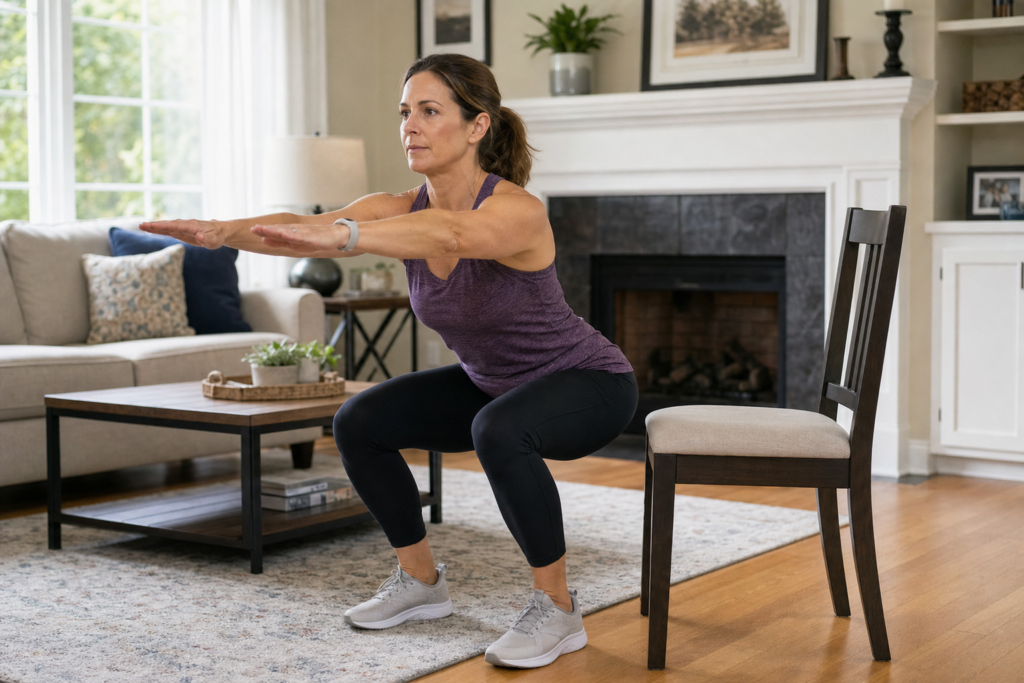
- Chair-assisted squats: Stand in front of a sturdy chair, feet shoulder-width apart. Lower yourself as if sitting down, tap the chair lightly, and stand back up. The chair is there for confidence, not support — try not to fully sit. This works quads, glutes, and hamstrings.
- Step-ups: Use the bottom step of a staircase. Step up with one foot, bring the other foot up, step back down. Alternate the leading foot each rep. Excellent for single-leg stability and glute strength.
Upper Body
- Wall push-ups: Start here if floor push-ups feel too hard. Place your hands shoulder-width apart on a wall, lean in at an angle, and push. As strength improves, move to an incline push-up on a counter, then eventually the floor.
- Seated overhead press with water bottles: Hold a full water bottle (or a can of soup) in each hand. Press both arms overhead and return to shoulder height. Targets shoulders and upper back.
Core
- Dead bug: Lie on your back, arms straight up toward the ceiling, knees bent at 90 degrees. Slowly lower one arm and the opposite leg toward the floor — keeping your lower back pressed down — then return. This is one of the safest and most effective core exercises for beginners because it avoids spinal flexion.
- Glute bridge: Lie on your back, knees bent, feet flat on the floor. Press your hips up toward the ceiling, squeeze your glutes at the top, and lower slowly. Works glutes, hamstrings, and lower back.
When You’re Ready to Progress
Once bodyweight movements feel manageable — once the two sets of 10 feel like they require very little effort — it’s time to add resistance. Resistance bands are inexpensive, versatile, and beginner-friendly. The Rock Hill Family YMCA also offers introductory strength training orientations and classes specifically designed for adults over 40, if you’d prefer a guided environment with proper equipment.
A Note on Soreness and Form
Mild muscle soreness 24 to 48 hours after a session is normal. Sharp pain during an exercise is not — stop and reassess your form or see a provider. Controlled movement with good posture beats heavy weight and sloppy form every time. Move slowly, breathe consistently (exhale on the effort), and pay attention to how your body responds between sessions.
Two days a week. Eight exercises. Twenty minutes per session. That’s enough to start reversing muscle loss, improving your metabolism, and feeling more capable in daily life — and you can begin today in your living room.